Some of the things that have been happening around town in Nikki while I was traveling about:
Chaleur. The Chaleur or hot season arrived and went full speed ahead in my absence. Yesterday was 102 Degrees F. Basically this means that from about 11 am until about 4 pm you are in a semi-coma state. As one of the few dividends of being driven out of your house during chaleur, I and my neighbors have been sleeping outside. Dusty wind and screaming goats aside(do they ever sleep?!), sleeping under the stars is a beautiful thing.
Power Outages. Nikki’s electricity, normally powered by a number of gas-generators, was recently brought to its knees, presumably by the heat. Now Nikki’s 5 quarters are taking turns with 2 small generators, which works out to 8 or 9 hours of power every other day.
Mango Season. One of the other silver linings to the hot season. These start ripening and dropping in April or so. Because it hasn't rained much yet, the big ("vrais") Mangos haven't yet dropped in Nikki. So I eat lots of the small ones. Yesterday I ate 9.
Elections. I came back to local elections week in full swing. This meant campaign posters everywhere and other political fare. And that pack of men gassing their motorcycles through center town? To the untrained eye, frat boys just getting out of a football game, but local closer and that's someone's campaigning centerpiece. Sunday the town went to vote, at one place in a booth partly corridored by a turned over car. When all the dust settle on election day, I was told that all went smoothly. Long live democracy.
My dog. The saddest piece of news coming home was that my dog Cowboy had fallen sick and died. Ostensibly, in the course of his daily rummage through a rubbage heap just outside my concession, Cowboy had found and eaten some really bad meat that someone had thrown out. Since Cowboy was the only dog in Nikki to have a name, a collar, and regular walks, I'm pretty sure many folks will miss him.
Tuesday, April 22, 2008
Friday, April 11, 2008
Dogon est Doux
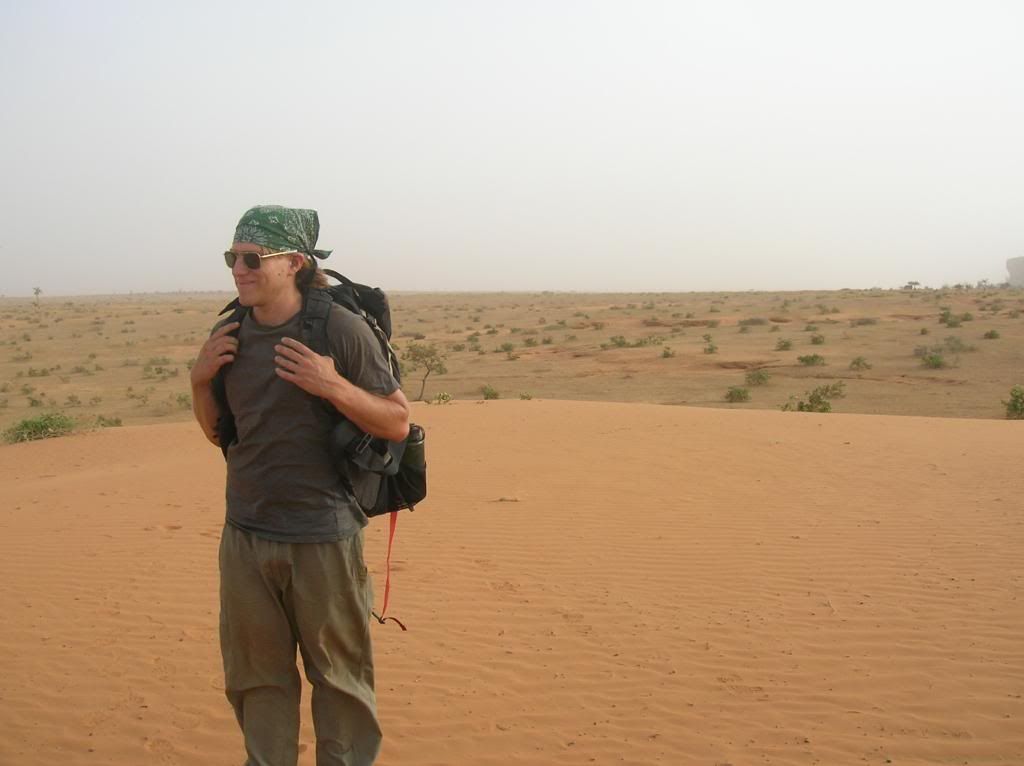 Returned recently from a 10-day trip through Burkina Faso and Mali with four other volunteers. Our main hits were Ougadougou (Burkina Faso), Pays Dogon (Mali), Mopti (Mali), and Djenne (Mali). In between was ALOT of miles of bush taxi discomfort and adventures.
Highlights?
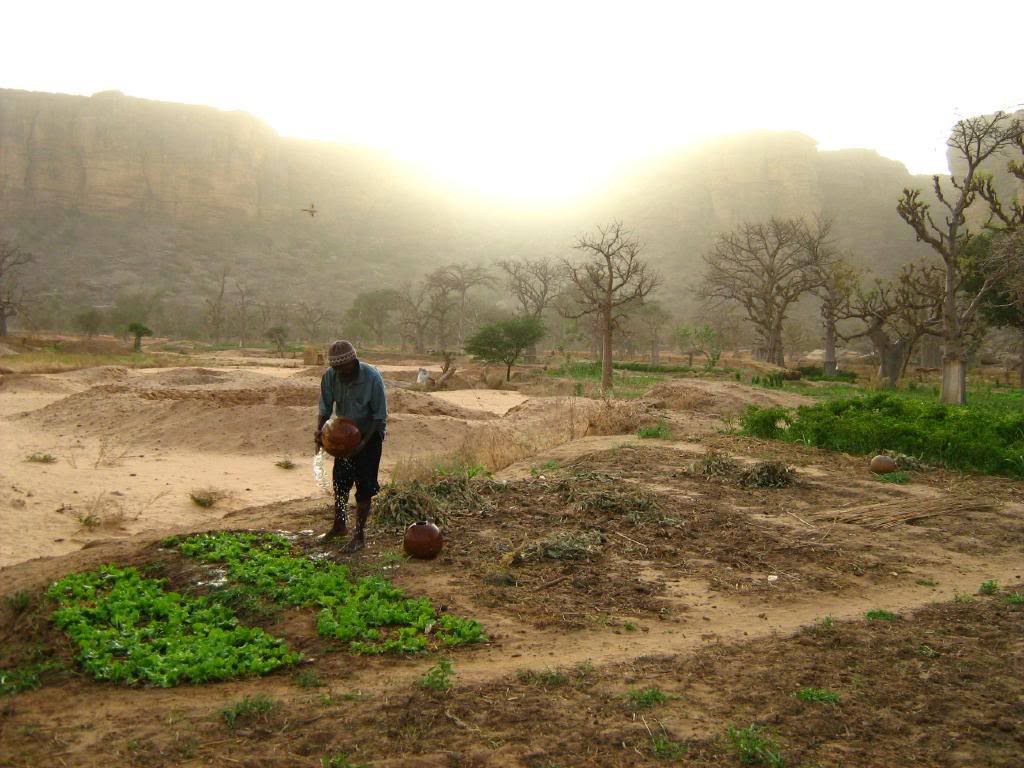
The top highlight of the trip was a four day hike through Dogon country, a region of beautiful escarpments in middle-Mali that for centuries have been inhabited by the Dogon people, cultivators who have settled at the base of, at the top of, and--in some places--inside these escarpments. Alongside "beautiful," the other word needed to explain this area is "fragile," as the very traditional Dogon villages are vulnerable to encroaching desertification, tourism, and other outside forces, the effects of all of which you can vividly see. We had a fantastic time trekking the area, sleeping on roofs, meeting the locals, and hanging out with our fantastic guide, Oumar.
The top highlight of the trip was a four day hike through Dogon country, a region of beautiful escarpments in middle-Mali that for centuries have been inhabited by the Dogon people, cultivators who have settled at the base of, at the top of, and--in some places--inside these escarpments. Alongside "beautiful," the other word needed to explain this area is "fragile," as the very traditional Dogon villages are vulnerable to encroaching desertification, tourism, and other outside forces, the effects of all of which you can vividly see. We had a fantastic time trekking the area, sleeping on roofs, meeting the locals, and hanging out with our fantastic guide, Oumar.
 Visiting Africa's largest mud mosque in Djenne, Mali's "sister" city to Timbouktou was another highlight. A cleaner, more accessible, and quite possibly more beautiful version of Timbouktou, Djenne is a Muslim city of North African architecture, winding narrow streets, and lots of camera-friendly kids.
Though the miles and miles of "bush taxi" we covered could only be described as "fun" by the chronic masochist, I feel that something should be said about this element that consumed about half of our trip. What would voyaging in Africa be if not done in style: Sahelian heat, harmattan dust, broken axles, flat tires, wooden benches, sharing space with peeing goats and dying cows.
I've posted some photos from the trip online. Link here to see the whole album.
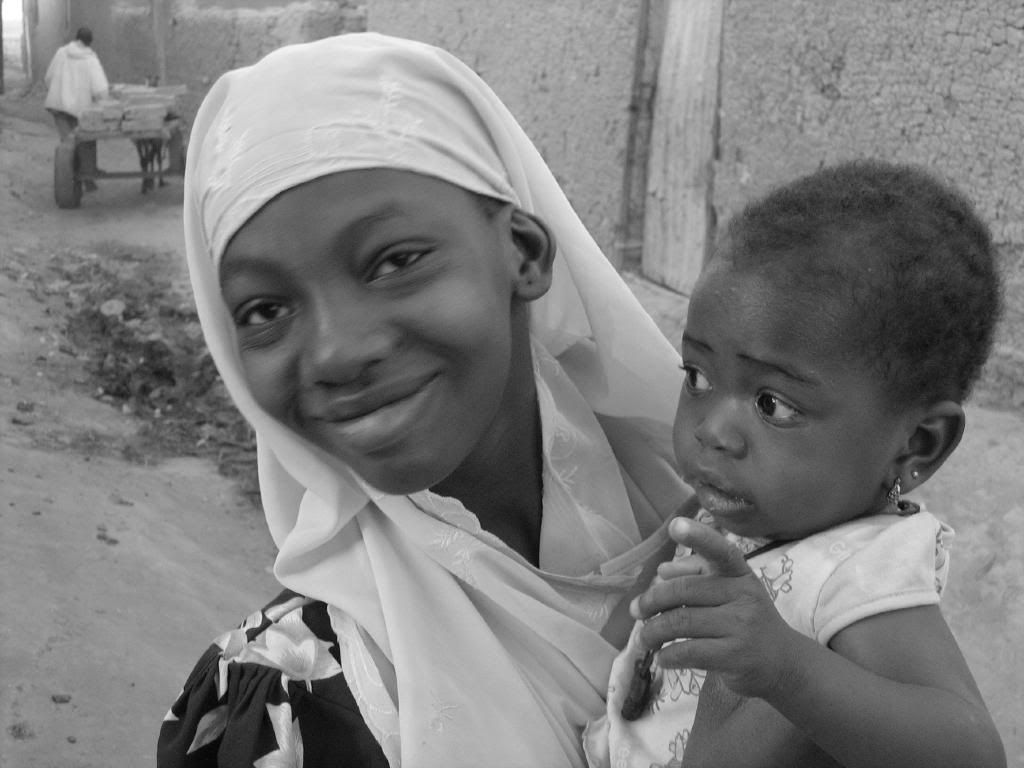
 Two sisters in Djenne.
 The world's largest mud mosque, seen through a house window in Djenne, Mali.
I and the other volunteers I traveled with, on a rooftop in Djenne.

Monday, March 31, 2008
All Vol Conference

At the end of March Peace Corps Benin had its annual "all vol" conference in Cotonou, basically to discuss the successes in the Benin program, as well as to suggest improvements. Thought it'd be good to post the photo taken at the end of the conference to give a visual idea of who makes up the program here in Benin.
Saturday, March 22, 2008
America in Africa: Why Bush was Pounding Shea Nuts
 The photo to the left (copywrite WATH, I think) is of Bush pounding Shea Nuts (which eventualy turns into Shea Butter) during his recent visit in Ghana. Ghana was one of the several stops (and this one of the many photo shoots) that Bush made during Bush’s February tournée of Africa.
Not sure how much U.S. media attention was given to this diplomatic trip, at least “positive” media coverage. I imagine not much. However, here in Bénin (one of Bush’s stops), Bush’s visit was quite a big deal vis à vis its political importance, the vast media coverage, and even what was talked about on the street by the typical Béninese. Bénin even shut down its sole international airport for several days, and extended a runway in order to receive Air Force One, if only for a couple hours (I’m told Cotonou didn’t have sufficient hotel capacities to lodge all of the President’s numbered traveling support staff overnight).
Such a warm welcoming, however, is probably indicative of how momentous an occasion this was for many Béninese. Many seem to see this visit, which is the first time the country has ever been visited by a current U.S. president, as affirmation that Bénin, led by President Yayi Boni, is emerging as an African Nation that is stable, veritably democratic, and economically competitive. Distinctions are all the more noteworthy when they are compared with the recent histories of many of Bénin’s West African neighbors.
Yet, as I listened to my shortwave radio throughout the time of Bush’s visit and heard opinions and reports coming in from across Africa, it seemed to me that most of the sub-Sahara—not just Bénin—looked favorably upon Bush’s visit. According to Pew Research, 8 of the top 10 world countries that give America the highest approval ratings are African.
Interestingly, some of this pan-African enthusiasm comes from many Africans’ approval of the President’s self\-assured (never mind sometimes misled?) demeanor and policies—he’s a man that doesn’t just talk, but takes action. But personal motivations aside, there are in fact very good reasons for Bush’s approval ratings in much of Africa. During the course of Bush’s presidency, American aid to Africa has increased threefold, into programs combating Malaria, AIDS, and corruption, among others. Bénin for example, has received millions of dollars (through the President’s Millinium Challenge Corporation initiative) to restructure, render less corrupt and more competive, its port in Cotonou. In the diplomatic world of many worthless words, America has also been one of the most aggressive international actors actually pushing for action in Darfur.
The realist will respond that the U.S. has its interests in Africa, too. Bush, at the end of his unpopular term, certainly was in need of some positive PR. Many are saying that the President’s visit to several West African countries (Bénin, Liberia, Ghana) were prompted my expectations that the U.S. will soon be reliant on this region for 25% of its oil imports. One correlative of the President’s war on terror has been increased friendliness and aid to certain Northwest and Eastern African countries proximate to the Arab-Islamic world. And then there is the raising of support (and the securing of a location) for AFRICOM, which beginning in 2008 will be the headquarters overseeing all U.S. military, diplomatic, and developmental operations in Africa.
Bush’s presidency has left no lack of cannon fodder to be fired back at him concerning the economy, the War in Iraq, and several big domestic issues. Yet I—and apparently many Africans— think the last 8 years have been encouraging for U.S.-African policy.
Friday, February 8, 2008
My Dog

The newest acquisition Chez Ryan.
His name is Cowboy, but this (and the collar) are about the only thing American about him.
Cowboy eats ignam pile and other Beninese food, responds to French commands, lives in a African outdoor kitchen (see open door in back of photo), and runs with all the other African fauna that happen to be outside the concession.
Small Business Training…and Hopefully More
While the majority of Bénin’s working-class populations (2/3) are engaged in the agricultural sector, the second largest demographic is engaged in service-sector activities. This service sector also generates just over half of Bénin’s aggregate income.
The service sector itself is composed largely of Artisans (and Artisan Entrepreneurs), a broad economic category which includes mechanics, electricians, metal workers, carpenters, tailors, hairdressers, food and drink producers, potters, artists, and small-scale transformers of various household products.
Among Peace Corps Bénin’s Small Enterprise Development (SED) objectives is the technical training of Artisans/Small Business Owners in business skills which will reinforce their organizational and management capacities, and helping to create linkages between markets that will spawn business growth and development for such small and medium-sized businesses.
Such an objective can include an array of activities for a Peace Corps SED Volunteer. For Artisans who have and/or manage their own shops, I recently began teaching Comptabilité (basic accounting). If successful, these formations (training) will not just teach artisans to “crunch numbers” and augment profit. As crucial as profit margins are to the life of a business, good business and development itself is not just about quantifiable growth and the bottom line. Rather, it is my hope that the analytical rigor that accounting demands will also trigger more analytical planning and problem-solving in other arenas of life. I also hope to use the general discipline of accounting to open up other important “less-quantifiable” topics of discussion, to include corruption and transparency, worker’s/employer’s and children’s rights, conflict-resolution, and the conscientious management of household/personal income and resources.
Aside from accounting, SED Volunteers also have taught formations on Marketing, Business Managament, Personal Finance, Savings and Credit, Time Managament, and other topics of practical interest to entrepreneurs. Additionally—pursuant partly to the demands of Sustainability—many volunteers offer formations to “train-up trainers.” These endeavor to teach business specific skills, offer guidance on teaching, and create a “system” of incentives that will ensure that low-cost technical business training continues when Peace Corps Bénin has left Nikki, and eventually Bénin.
The service sector itself is composed largely of Artisans (and Artisan Entrepreneurs), a broad economic category which includes mechanics, electricians, metal workers, carpenters, tailors, hairdressers, food and drink producers, potters, artists, and small-scale transformers of various household products.
Among Peace Corps Bénin’s Small Enterprise Development (SED) objectives is the technical training of Artisans/Small Business Owners in business skills which will reinforce their organizational and management capacities, and helping to create linkages between markets that will spawn business growth and development for such small and medium-sized businesses.
Such an objective can include an array of activities for a Peace Corps SED Volunteer. For Artisans who have and/or manage their own shops, I recently began teaching Comptabilité (basic accounting). If successful, these formations (training) will not just teach artisans to “crunch numbers” and augment profit. As crucial as profit margins are to the life of a business, good business and development itself is not just about quantifiable growth and the bottom line. Rather, it is my hope that the analytical rigor that accounting demands will also trigger more analytical planning and problem-solving in other arenas of life. I also hope to use the general discipline of accounting to open up other important “less-quantifiable” topics of discussion, to include corruption and transparency, worker’s/employer’s and children’s rights, conflict-resolution, and the conscientious management of household/personal income and resources.
Aside from accounting, SED Volunteers also have taught formations on Marketing, Business Managament, Personal Finance, Savings and Credit, Time Managament, and other topics of practical interest to entrepreneurs. Additionally—pursuant partly to the demands of Sustainability—many volunteers offer formations to “train-up trainers.” These endeavor to teach business specific skills, offer guidance on teaching, and create a “system” of incentives that will ensure that low-cost technical business training continues when Peace Corps Bénin has left Nikki, and eventually Bénin.
Saturday, January 19, 2008
Bettering Lives by Making Butter
 One of my primary projects here, commissioned by a local NGO L’Enfant Epanoui Bénin and by project financers, will be delivering assistance to three local women’s groupements in the income-generating production of Shea Butter.
In Bénin and across West Africa, a groupement is a group of women (in this case about 30-40) who form some economic collaborative such as the cultivation, preparation, and selling of vegetables, yams, soybean products, cheese, etc. Our groupements are in the business of Shea Butter.
Shea Butter is more recently known to the States as an ingredient to certain beauty products or as an item in the natural products niche market, given Shea Butter’s veritable uses and its supposed homeopathic qualities. But in West Africa, the only region where the Shea Nut (coming from the Karité tree) naturally grows, Shea Butter has been used for centuries for a plethora of household ends, most notably as a moisturizer, healing product, and for cooking.
Although Shea Butter has been produced across this sub-Saharan strip of Africa for generations, most groupements (being the most common producing agent of Shea Butter) employ the same tools and methods always used. Basically, the women will de-husk the nuts with a mortar and pestle; further remove moisture from the already dried nuts by grilling them over a fire; run this through a mill; enliven and “refine” the butter through a lengthy and technical process of kneading, cooling, then boiling the paste; then leave the refined oil to dry into butter in calabash bowls. The end product, as you will see it in a local marché, is a spherical greenish/crème-colored solid with a earthy/nutty taste and odor.
 According to my own observations, transforming a 25kg of dried Shea Nuts takes: about three days, the manual labor of several women (at least), and about 4300 CFA (about $8.70) in direct costs. Yet, in the local market such a transformation will yield only about 5,000 CFA (about $10.00) in sales for the women to divide up or reinvest in the next production cycle.
Our project hopes to cut the direct and indirect costs of the production cycle by purchasing for each groupement a machine that effectively subverts the time spent de-hulling, and the money spent running the nuts through the mill. We also hope to regularize the quality and quantity of production enough such that we are able to export raw Shea Butter to a buyer in the States (where demand for raw Shea Butter is catching on fast) or Europe. According to my preliminary research, in these markets one can generate revenues of more than four times that in the local Béninese marchées. If such a point could be reached (indeed, many groupements across West Africa are already selling directly to buyers), our groupement women and their families could benefit greatly from the sustainable supplemental income that is generated.
Supplementary and complementary activities will include the replantation of Karité trees in the our locality; community sensibilization concerning the problem of desertification; and the technical training of the women’s groupements concerning topics such as accounting, shea butter production techniques, and others directed towards the better well-being of their households.
Photos:
Top Left: A woman from a local groupement sells Shea in the Nikki Marche.
Bottom Left: A drawing depicting the kind of Machine Production of Shea Butter that is replacing more traditional methods. Acquiring such technology will greatly economize our groupements Shea transformations.
Subscribe to:
Posts (Atom)